The Case for A Mental Model Interpreter
Why Training AI Agents Should Include Your Ways of Thinking

If you’ve caught the agentic AI fever (and given that you’re reading this, I assume you have), then you’ve no doubt come across tutorials and thought pieces on the “best” methods to craft your agent. I’ve read a number of them, ranging from crypto bros espousing fantasy storytelling techniques to tech leaders from Stripe and Anthropic providing the results of their companies research (the parts they want to share at least). People share templates, compare system instructions, debate the merits of chain-of-thought versus structured output schemas. There’s genuine technique and strategy involved in all of this, and I don’t want to dismiss it. But I think the conversation is missing something significant. The framing of prompts as a holy grail for agentic instructions overlooks that humans have unique methods of thinking and communicating, and I believe building methods in our agentic frameworks to account for this dynamism is worth exploring.
Your Mind is Part of the Equation
There’s a common saying: “Wherever you go, there you are” most commonly associated with a book on mindfulness, although the phrase has deeper roots in Buddhist and contemplative traditions. The idea is simple: No matter how much you change your environment, your own patterns of perception and interpretation follow you.
The same principle applies when working with AI agents. How our own minds work is integral to the feedback system of what an agent does with our input. Each interaction is filtered through what cognitive scientists call our mental models, the internal representations we carry about how the world works, how systems behave, and what we expect from a given interaction.
A mental model is essentially an internalized framework that a person uses to understand, predict, and reason about the world around them. It’s not a perfect mirror of reality, it’s an abstracted, personal map shaped by experience, expertise, and context. When you assume that clicking “save” will persist your work, or that a colleague will interpret “ASAP” with a certain urgency, you’re operating from a mental model.
Current thinking in cognitive science frames mental models not as static structures but as dynamic, context-dependent schemas that people continuously update through experience. Researchers have moved away from the idea that there’s one “correct” model in a person’s head, recognizing instead that people maintain multiple overlapping models and switch between them depending on the situation. This has significant implications for fields like UX design, education, and now, agentic AI development.
Every person relies upon their own mental models when communicating with others, and that includes working with agents. For those who have not integrated agents into their daily work-stream, it is helpful understand that ones communication style with agents mirrors that of other close relations, for instance a spouse. The first time we meet, we are considerate, patient, and on our best behavior. As familiarity grows, so too do our personal communication shorthands, and our notion that the other should have enough context to just understand what is being conveyed. Recognizing this pattern is the first step towards having communications (and designing agents) that interpret not just what we say, but what we’ve stopped bothering to say.
This phenomenon of communication break down occurs with AI agents as well. We build the agent, lovingly craft its instructions, and delight when it works. But then we use it daily, under pressure, whilst distracted - and it starts to fail. The cause is rooted in the shift of our communication style, but it is often hard to realize that.
For the past three months, I’ve spent an increasing amount of time building and babysitting AI Agents to help my various needs. I also teach other engineers (and non-engineers) on how to build Agents for themselves. I have seen over and again the frustration with agents when performance falters. It was during a late night optimization of Claude that I realized my own variation of input might be part of the problem. I stopped attempting to tweak my agent and, instead, focused on methods of interpreting my own instructions. The results were a significant reduction in false starts and misinterpretations.
This is what led me to conceiving of a mental model interpreter (MI). MIs join your agent team to assists in the translation layer between human thinking and agent execution. Like an interpreter at the United Nations, the MI skillfully understands how you think and how information should be presented to Agentic Systems. Ideally, the interpreter learns alongside you, it helps across agents, and overtime becomes adept at understanding your individual ways of thinking.
Want to give it a try? Doing a self-reflective analysis on how you speak to AI agents can be quite illuminating. Ask your LLM of choice:
“Review the way I’ve communicated with you across our past conversations and give me an honest, direct assessment of my communication style with AI. Tell me how I express dissatisfaction, how I tend to work through conflict or disappointment, how I give positive feedback, and what strengths, blind spots, or recurring patterns you notice in how I collaborate with AI.”
When I did this experiment, one item I was told is that “the model gets a lot of detailed correction and relatively little detailed reinforcement.” I wasn’t providing reinforcement on the positive aspects, and missing half of the equation on tuning my agents. I have since tried to notice successes, especially where I was surprised by the quality, and taking the time to explain in my AI instructions what I liked.
Building Your Own Mental Model Interpreter
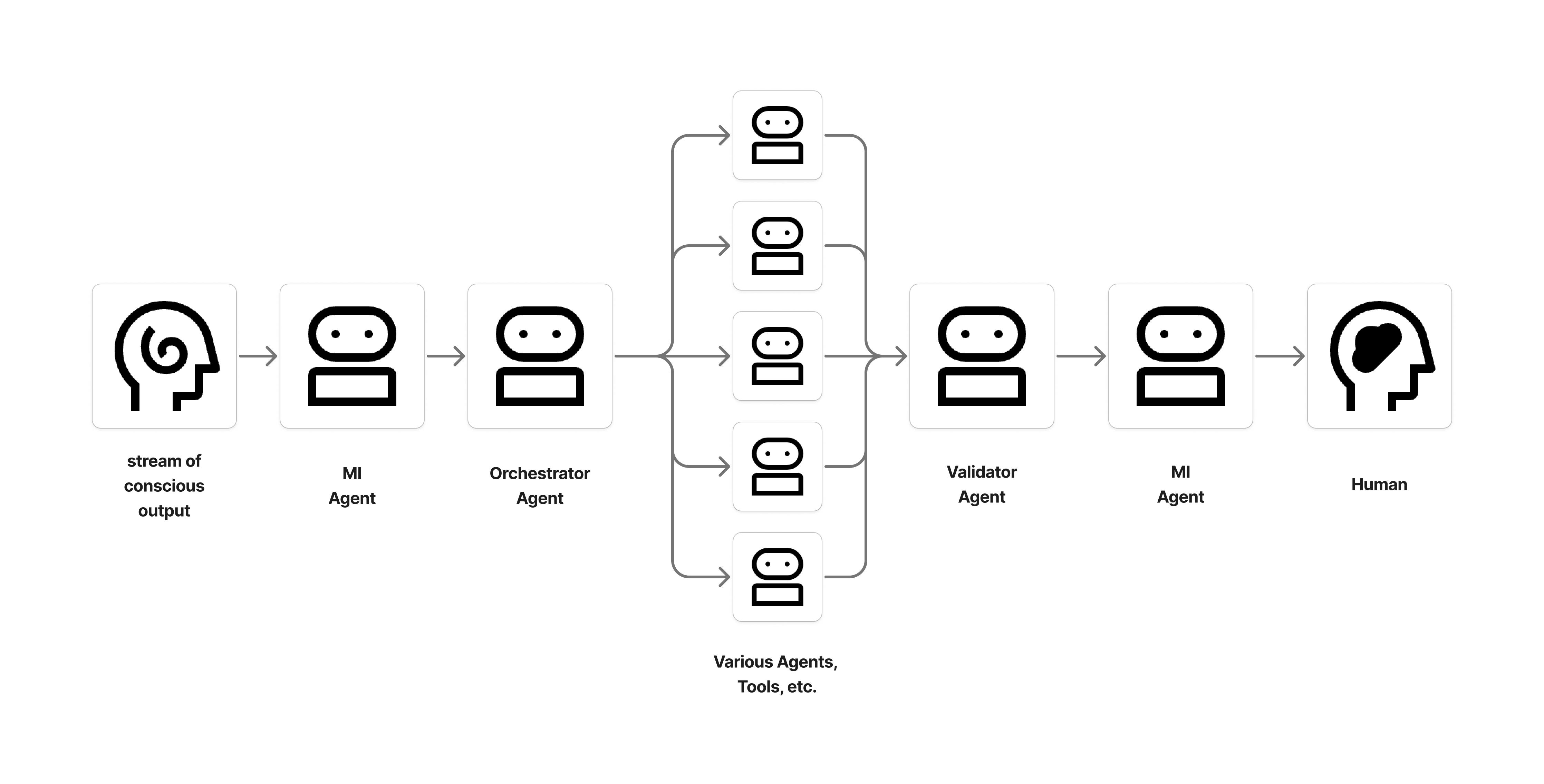
Agents that you build for yourself are a prime testing arena to experiment with creating AI agents that are optimized for your prompt style. Because you are the only human in this feedback loop, you have clear insight into what inputs are being added and what the intentions of the user are. You know exactly when an agent misinterprets you, and you can trace that misinterpretation back to your own patterns of communication. The only challenge is interrupting your build flow to be a meta-critic.
The method I employed was to keep a text file open, and any time I thought the interpretation was off I would: 1) copy the prompt 2) copy the summary or portion of the result, and 3) write my own notes about what my original intention had been and why the AI got it wrong.
Every so often, I feed this into a separate LLM and ask it to interpret what about my prompt caused the misinterpretation. From there, I was able to assemble patterns about which styles of communication trigger poor results. Finally, I use this to assemble the MI, running through the file of prompts I saved to produce new outputs and seeing if that performs better.
For my own work, here are some patterns I’ve identified and addressed with an MI layer:
Gaps in detail. I tend to skip steps or under-specify what a successful result looks like. I know what I mean, but I haven’t articulated the acceptance criteria. The MI reviews my input and flags where more detail is needed before anything moves downstream.
Non-linear instruction. When I’m in stream-of-consciousness mode, I jump back and forth across instructions, starting on one thought, pivoting to another, and then circling back. Having the MI organize the flow better, changes the quality of execution..
Contextual reference lookups. I like to maintain a reference index: past projects, client details, team members and their roles at Nullwest . Information that I can refer to conversationally and have it injected into the context window automatically. The MI can detect terms and entities in my input, run lookups, and enrich the prompt with the information the downstream agents actually need.
Engaging External Audiences and Building AI Brand Voices
The same approach scales when you are building agents for external audiences. At Nullwest, we are currently developing AI products for a wide range of audience types from early signs of dementia, to an AI art concierge people are discussing artwork, asking questions, and framing things through an aesthetic and cultural lens.
These audiences think, speak, and frame things in fundamentally different ways. Their vocabulary is different. Their emotional register is different. Their expectations around what constitutes a helpful response are different. An MI tuned for one would perform poorly for the other.
By analyzing how an audience communicates, ask questions, and frame topics is enables the creation of an MI that operates as part of an AI brand voice work. A good MI will interpret in both directions of the conversation, how the audience will input information (their questions, framing, and language) and how responses should be shaped going back out to that audience (tone, voice, style, level of specificity). The MI can work bidirectionally: inbound understanding and outbound brand voice. This is where audience-driven prompting converges with brand strategy, and it’s an area where I think there’s significant unexplored territory. Brand Voice tools are something I’ve been actively building and am hoping to write a future article on.
Dave Jimison is a quarter-century tech industry veteran and managing partner at Nullwest, where he leads product innovation. His work focuses on a phenomenological perspective to augmented cognition — connecting how people actually think with how technology should be designed to support them. He is always looking to connect with others thinking critically about our current technological systems. Engage with comments, and subscribe if you’d like to follow the thread.